Dan Heller's Photography Business Blog Industry analysis from www.danheller.com

The photography world -- the business, the culture, the art, the politics, the technology.

Site Feed

Subscribe to
Posts [Atom]

My Photo
Name:
Location: Santa Cruz, California, United States
My Books on the
Photography Business

Sunday, July 01, 2012

Royalty Free no longer exists


I have always gotten a continuous stream of questions about Royalty Free vs. Rights-Managed images, and I usually just send people to numerous posts I've written in the past.

But a recent email to me concerning Photoshelter's use of the terminology compelled me to post a short blog entry on the subject to try to make it even simpler to understand.

Royalties are payments made to authors (photographers in this case) in exchange for the right to sell works (images). The moment any photographer is ever paid anything by an agency, s/he has received a royalty. Even if it's a one-time payment.

Rights Managed ("RM") means that someone has the right to say how a photo may be published. There's always someone that has the right to manage a work's usage terms. Yes, "unlimited, unrestricted use" is still "managed" if that's what the rights manager wants. Even public domain and creative commons are terms stipulated by someone -- usually the author.

By definition, ALL images are Rights Managed, even if the manager chooses not to assert those rights, or is very liberal about how others may use the photo.

Royalty Free ("RF") refers to a special kind of license agreement that can only take place between two stock photo agencies. Here, the primary stock agency grants another agency the right to resell images, and that second agency is under no obligation to pay royalties back to the photographer.

Why would such a thing happen?

Before the internet (and up till mid-1990s), distribution of images to buyers was difficult. Smaller stock agencies that couldn't sell some supply of images started selling them to OTHER stock agencies with better distribution channels (usually, the early internet adopters). Because these images were usually lower quality, the concern was that these images might not sell. In order for the deal to make financial sense for all parties, the photographer was paid a one-time royalty for the transaction, the primary agency got a single, lump-sum payment from the secondary agency, and that second agency was now on the hook to make some money. Sometimes they did, but often they didn't. But they could only agree to take this risk so long as they were not obligated to pay royalties back to the photographerThese were royalty-free images

At the time, photographers were finally making money from images that would have otherwise sat unsold, and the smaller agencies were often seen as tributaries to the main stock agencies, who themselves were taking advantage of a very quickly expanding base of buyers because of the growth of the internet.

As the idea showed profitability, more agencies started selling and reselling the same images in the same way to many stock agencies, creating a huge market for RF images. Each time, the photographers would get royalties from each such sale. And, in each case, the "royalty free license" meant that each (secondary) agency down the distribution channel was not obligated to report sales or pay royalties to the photographer.

The tipping point came when the ease and cost of access to the internet allowed those smaller agencies to sell directly to the buyer. And, for the buyer to find those images through better search engines. The need to feed the primary agency networked collapsed, which coincided with the time when Getty's stock price was plummeting from the mid-$80s to the low $30's, when they were finally taken private. Note: Getty's price didn't plummet because of the rise of RF images. The entire economy of images was falling precipitously because no agency could control (choke) the supply channel any longer. All agencies were hurting and RF was no safer than traditionally-licensed images.

I am currently unaware of any actual Royalty Free Licenses being used in photography. I believe it no longer exists. (The practice is still used for clip art, icons and some other kinds of media (smaller music labels) where channel distribution is still difficult.)

So, why are the terms, "RF" and "RM" still used? 

Remember how those secondary agencies were on the hook to monetize these images or lose money? They did so by enticing buyers with very liberal license terms, such as "unrestricted (use), unlimited (time)."  Thus, photographers (and later, newbie agencies that didn't understand history) misunderstood RF as implying these unrestricted usage terms. For a long time, RF really did mean "unrestricted."

But I rarely see such license terms anymore. Even the license terms used by today's agencies for their so-called RF images are often not as liberal as the original RF terms once were.

Today, the terms "RF" and "RM" are interpreted mostly by PHOTOGRAPHERS to mean that they will make more money with RM images than RF, even though those economics are not as predictable. My personal opinion is that the terms remain simply to attract (and direct) photographers towards certain business terms with the agency. Most buyers have no idea what they mean... nor do they care. They only care about the terms of use, which has nothing to do with RF or RM.


Labels: , , , , , , , , , , , , ,

Thursday, March 15, 2012

Pinterest Copyright Infringement: Yeah, so what?

The latest hot startup in the photo-sharing space is one that is also creating a lot of controversy about copyright infringement. Pinterest lets users create "boards" of images they find from around the Web. Users “pin up” these images, and share them with friends and strangers.


Is this copyright infringement,” you ask?


Well, imagine exactly the same website that let's users upload music or movies. Do you think the music labels or movie studios would permit this? Pinterest would be shut down before they could get their first dollar of venture capital.


“But they’re photos, not music or movies!”


Yes, and photos have precisely the same copyright protection.


“Ok, wise guy, then why hasn’t Pinterest been shut down?”


Simply put, there’s no one there to stop them, at least not with the same effect and scale as music labels or movie studios. And the reason is reflected in your very statement: society simply regards photos as “different” from movies; they don’t see Pinterest’s use of imagery as copyright infringement.


And this is a natural feeling to the common person. Everyone shoots pictures all the time; it takes milliseconds; most people don’t invest any thought or intent. By contrast, music and movies require considerable time, effort and expense to produce. So, there’s a difference.


And herein lies the unresolved problem: the law is the law, and photos are copyrighted works, regardless of the time, skill, or anything else necessary to create them. Accordingly, photos are supposed to enjoy the same legal protections as music and movies.


“I see. But, most people want and expect to share their images with others.”


Yes! Their images. Pinterest isn’t letting people share their own photos; they’re sharing other people’s photos.”


“Ah, I see now.”


Very good, Grasshopper.


As a society, we permit this kind of infringement, which explains why there are no large, powerful, influential organizations representing the interests (and the copyrights) of photographers. People simply regard photos as different.


A case in point can be found in this article on chow.com, discussing people’s reactions when they found their recipes were being “pinned” to Pinterest, along with the photos of their foods. The complaint was that their intellectual property (cooking recipes) were being stolen; the recommendation: “Just allow the photo to be shared, not my recipe!”


You see? Never mind the pro photographers whose pictures were being infringed; they’re not part of the conversation.


“Ok, so what about those professional photographers? How are they hurt?”


I’ve been a photo industry analyst since the mid 1990s, and I’ve seen the industry suffer more from “piracy” than the film and music industries combined. Every single publicly traded stock photo agency has either gone out of business or withdrawn from public trade. Getty Images is the last profitable company of any significant size, and even then, its pay to photographers has been drifting lower for over ten years to maintain that status. A series of studies from Picscout – a photo-tracking service for stock agencies and photographers – finds that 90% of commercial websites use at least one photo in a manner considered to be “commercial use” without the copyright holder's authorization. No company whose business model is to sell or license photography has had venture capital investment since 2000.


Yet, the shadow economy for photography is enormous. In a study I conducted in 2007 on contract for a potential investor in a photo-related technology, I found that most photo buying and licensing was done on a peer-to-peer basis, mostly in local markets and exchanges, at a scale that suggested the total economic activity tipped at $25B/year. Yet, none of it can migrate online because of the “perception” that photos don’t count when it comes to piracy, and because there was no possible infrastructure to enforce legal protections.


So, yes, the photo industry has been starved to near extinction, compared to what it could be if it similar legal representation that the music and movie industries do.


“My gosh, I’m getting sad. But I still want to share photos online.”


Don’t misunderstand me; I’m cognizant and sympathetic to the non-professional side of photography and the social value of sharing images, both culturally and economically – including to those photo-sharing sites like Pinterest. There’s no question that people should be able to share images online with others in an unfettered manner that Pinterest provides, as well as every social network.


But to do so in compliance with copyright law would require a series of rights access that cannot be scaled up to serve the public at large without a centralized (and streamlined) rights clearinghouse. Legally speaking, Pinterest should obtain rights from “everyone,” but it’s not possible because people are uploading other people’s photos. If there were a central clearing house open to everyone – say, like the music labels have – Pinterest could enter into a unified license agreement.


Without such a clearing house, the law is the law, and the courts will eventually be forced to reconcile the law with society’s desires. Well, provided cases are brought to court to press the issue.


This is not new. Copyright itself has been a controversial topic for society (and justice) for years, and continues to this day. On one hand, there are many who believe that copyright protection should be lifted, if not severely curtailed, largely in order to avoid this very problem of the social benefit from photo-sharing. Economists, on the other hand, understand that the creative economy only exists because people can earn a living from their efforts—that "human creativity is the ultimate economic resource." (Florida 2002) If they couldn’t economically benefit from their creations, society would suffer more, since the lack of incentives (and hence, resources) would starve an important and socially valuable industry.


The only legal basis for dealing with this dispute continues to reside in the Copyright Act in 1976, which states that “copyright protection extends to original works of authorship fixed in any tangible medium of expression,” including photography, of course. Tightly coupled with the Copyright Act is The Berne Convention, which states that “Copyright must be automatic; it is prohibited to require formal registration.” Yes, the USA provides added protection that permits authors to register their works with the Copyright Office, which then affords them “statutory damages” in legal claims, which guarantees the copyright holder a minimum of $750 per claim, and up to $150,000 if the infringing party “willfully infringed” (that is, with intent). But this registration is not required in order for the copyright to be held by the person holding the camera, and that ownership comes with rights.


So, Pinterest and other social networks are technically contributing to copyright violation by permitting other users to upload unauthorized copyrighted works. This is called “contributory infringement.” This Wikipedia excerpt explains, “indirect infringement arises when a party materially contributes to, facilitates, induces, or is otherwise responsible for directly infringing acts carried out by another party.”


These underlying legal principles of copyright law are subtle, and few are as educated on it as they like to believe—especially corporate law firms that write the legal mumbo jumbo in “terms of service” agreements (TOS). To wit, Pinterest’s own TOS stipulates that when you upload a photo to Pinterest, you are granting it a "perpetual, irrevocable, royalty-free license to use” your photos on its site and "application or services." While this is applicable if you own the photos you upload, you cannot grant this permission for photos that aren’t yours. That is, you are not the legal authority of someone else’s photos. So, Pinterest’s own TOS is unenforceable on photos that the user doesn’t own, which is pretty much all of them. So, strictly speaking, their TOS is toothless, pointless and moot.


But this is also besides the point: the user violated the copyright, not Pinterest.


So again, who’s to complain? To whom? Against Whom?


One could try to sue Pinterest, which is where their lawyers would quickly seek protection under the Digital Millennium Copyright Act (DMCA), which states that websites that host content uploaded by users cannot be held liable for copyright infringement, so long as the site complies with “take down notices” from those copyright holders. Here, the original owner of the copyright notifies the company with a “take down notice,” and the company is off the hook—no TOS necessary.


Many companies – Pinterest, included – very effectively use the DMCA as the “get out of jail free” card, effectively keeping their business out of legal danger.


But once again, we come back to the subtleties of the Copyright Act. As stated earlier, Pinterest could be liable for secondary infringement, which would make them ineligible to seek protection from the DMCA. For matters relating to copyright, courts would have to decide on the merits of such claims solely on case law developments.


This brings us to landmark cases, such as Napster and most notably, Grokster, where courts have established a three-point test to determine if a website “induces infringement”: (1) whether the majority of the content uploaded by users is infringed works; (2) whether the site provides tools that can only be used to infringe; and (3) whether the use of the works are (a) for commercial purposes or (b) harms the commercial interests of the copyright holder.


In the case of “majority of content,” this part is pretty self-evident.


In the case of the site providing tools that are “only” used to infringe, Pinterest’s defense would have to be based on a finding by the Supreme Court in “Sony Corp. of America v. Universal City Studios, Inc,” where the court found that, contributory liability cannot be imposed unless the technology lacks substantial non-infringing uses. Flickr, for example, only provides an “upload” button that allows users to upload images from their own hard drive. This provides “substantial non-infringing uses.” Indeed, the content on Flickr has most of its images uploaded by the original photographers themselves. Pinterest, however, cannot demonstrate this: their tool does not permit uploading photos from one’s own computer; in fact, it encourages users to pin photos from other sites.


The third test –commercial profit– also has roots in the legal doctrine of “Vicarious Liability,” where “courts have extended liability to those who profit from infringing activity when an enterprise has the right and ability to prevent the infringement.”


If someone were to go to the effort of showing that Pinterest satisfies all three tests, the company loses its DMCA protections, and must now face the music. This then re-engages copyright law, where the company could be liable for statutory damages if any of the works are registered with the copyright office. (Many pro photographers whose works are generally passed around the most, actually register their works.) Statutory damages mandate a minimum of $750 per infringed work, although a judge can raise the limit of the claim up to $150,000 per infringement if the defendant was deemed to “intentionally infringe.”


One would assume that if a site lost its DMCA protection because it was “inducing infringement,” then a judge would likely also rule that the infringement was “willful.” Hence, the $150,000 per image claim would be a hefty speeding ticket.


“Sounds troubling for Pinterest! Are they in trouble?”


Probably not. And it’s not because they aren’t in violation of copyright law—they are. It’s back to the basic question of “who’s going to sue them?” Unlike music and movie companies that have hoards of lawyers representing their interests and who aggressively shut down websites and file legal claims perpetually, photographers have no one. As individuals, photographers are too unsophisticated to navigate the difficult and expensive litigation process, so it is highly improbable that many will sue. And even if they did, they won’t be able to do so in a critical mass necessary to materially affect the company the way may music labels can. And even if they could, they’d be up against the same free-speech advocates that defended Grokster. This would not be an easy or inexpensive task, and would probably garner a large push-back from society who already regards photos as “different.”


I don’t mean to “pick on” Pinterest, actually. They are but one of many such sites. Polyvore not only satisfies the three-point test of “inducing users to infringe,” but their volume knob goes to 11: They offer even more sophisticated tools to infringe, including software that specifically designed to copy photos from other sites, while also providing no tools to upload users’ own photos, which flies directly into the face of the definition of Contributory Infringement, and satisfies the Supreme Court’s own language on whether the technology has a substantial “non-infringing use.” Worst of all, they are actually selling products, not advertising, which satisfies “Vicarious Liability.”


And their legal problems go beyond just copyright. Users also upload photos of celebrities to adorn the products sold on the site, which could be in violation of publicity laws if there isn’t a model release. (Cameron Diaz’s picture is one of the most popular.)


Polyvore does provide its own photos, which are legitimately licensed -- namely, from the companies selling the products depicted in the pictures. The test is whether the majority of the content uploaded by users are unauthorized. Other factors that appear to implicate their “knowledge of willful infringement” is a statement warning people not to infringe, and the promise they will take down photos if contacted by copyright owners. While one could argue that they are trying to give notice, this is akin to warning labels on cigarette boxes. No one’s fooling anyone here.


There’s no doubt that Polyvore knows its users are infringing, and it’s certainly possible that they are aware that they are also “inducing” infringement, but they are counting on the same two factors that Pinterest is: society accepts copyright infringement of photography, and more importantly, there are no special interest groups that will sue them for “contributory infringement” on behalf of a class of photographers.


“So, as long as society has accepted photography as a non-threatening step-child in the copyright debate, these sites are safe.”


The force is strong in you, young Jedi.


Still, the risk profile could suddenly spike if there were an unintended rise of those who would intend to assert those copyright protections, which could happen if incentives were to suddenly materialize. For example, a SOPA-like legislation.


“Huh? SOPA? Come again?”


Although the Stop Online Piracy Act is dead for now, the music and movie industries are not about to let it go. Something will eventually re-emerge with new and different terms. We’re already seeing a great deal of anti-piracy legislation coming out of Europe, and Congress and others are under a great deal of pressure to do something (probably after the election season).


What needs to be considered is the unintended consequences that might result if they don’t reconcile the incompatibilities between the social aspect of photography and the fact that it’s a copyrighted work. For, whatever law that has the intention of protecting movies and music just might create a financial incentive for new actors to enter the stage and try to represent the interests of the entire class of photographers, professional and otherwise. And the social networks that use photos are far bigger and vulnerable than the usual targets that music and movie studios attack, escalating the size of litigations that could arise.


A poorly drafted SOPA-like law could affect the internet in highly unexpected ways, akin to the sudden and immediate changes we saw in our political system after the Supreme Court’s decision on Citizen’s United.


“So, do you have a better solution?”


Funny you should ask.


I don’t believe one can ever legislate around this problem. There are two economies at play all the time: a legitimate one and an underground pirate economy. The best you can do is create so much incentive for people to participate in the legitimate economy, that the efforts to pirate become less interesting and less profitable, yielding a progressively smaller proportion of that industry’s total economy. Steve Jobs pleaded with the music industry to remove music locking in song files using the argument that people don’t want to infringe, so long as they can get access to what they want at a fair price. When the music industry finally agreed to remove those locks, online music sales spiked. But the music (and film) industries haven’t kept up with cultural and technological trends in how they handle the business side of their industries. They are still trying to solve 21st century problems with 20th century attitudes.


It’s not that I disapprove of litigation – it’s the music and movie industries greatest advantage. The legitimate marketplace exists because music and movie companies have the infrastructure to enforce copyrights; this is the stick that gets people to seek the carrot, benefiting the entire marketplace financially and fairly.


When it comes to photography, there is no infrastructure for enforcing copyrights, so there’s no viable marketplace. I mentioned that there needs to be a central clearing house for photo rights management: My solution to that is here.


________________________________

On Fri, Mar 16, 2012 at 4:15 AM, wrote:

When a person makes a board and posts other people's photos, isn't it just like sharing a link on a blog? When you click on the photo it goes back to the original website that it was found, doesn't it? I don't understand how that constitutes infringement, to me it's like a beefed-up hyperlink. Are you saying that they are literally taking photos and uploading them somewhere?

Literally copying content is one form of copyright infringement, but that's not what we're talking about here. The fact that the content is merely "displayed on a website not authorized by the copyright holder" is technically an infringement.

To illustrate, let's take your text, and change the word "photo" to "movie":
When a person makes a board and posts other
people's
movies, isn't it just like sharing a link on a blog?

In this case, let's say that those "other people" are movie studios. Here, the the public that views this movie is able to see it on a site that has not been authorized to show the movie. The movie studio doesn't care that the movie also happens to link back to their site, or iTunes, or amazon, or anywhere else. The content itself is displayed on another website without authorization. That is an infringement.

Your question of "link" should not be conflated with "text links," which do not display original content. For example, the text link "click here for this photo" is not an infringement because content is not being displayed.

You may say that "photos are different" because photos aren't like movies, or that movie studios charge money, or anything else. Copyright law does not distinguish between media formats or financial intent or even who the owner is. Copyright law is there to allow copyright holders to choose how their content is used.

Many people think that content can be used unless the copyright holder objects, but that is not the case. Technically, the copyright holder must grant consent first.

I realize this would suddenly make everyone aware that every social network in the world is suddenly in gross violation of copyright, and that's why the legal system and the copyright "process" needs to be updated to reconcile this.

Labels: , , , , , , , , , , ,

Friday, March 02, 2012

Market Efficiencies and Stock Photo Pricing

In my last blog post, Selling Stock: It's About Search Rank, Not Price, I argued that the price variability in the stock photo industry can be exploited by those who garner high search rankings. The rationale is that the direct and indirect cost (overhead) of finding an image so far exceeds typical license fees, that photo buyers are more indifferent to those license fees than sellers believe. Thus well-ranked photo sites would be able to command higher license fees, simply because they have first access to the buyer.

In fact, well-ranked photo websites are undermining their own profitability by lowering prices unnecessarily, mostly because they are following their perceived competitors, not because the customer is demanding lower prices. Their rationale would follow traditional economic theory under most market conditions, but therein lies the exception. The photo industry does not represent "normal economic conditions." Indeed, the photo industry represents a classic case of an "inefficient market."

Let me explain by starting with the definition of an "efficient market." It can be summarized as a market of buyers and sellers engaging under conditions where all information is available to parties on both sides of a transaction. (See this wikipedia link for extended definitions, examples, and citations.)

Examples of efficient markets are exchange-traded commodities like oil, orange juice and automobiles, among others. Here, producers of commodities make their wares generally available, and market-makers trade on this information. It is exceedingly difficult (if not impossible) to have inventory that the market is unaware of, or to purchase commodities without the broader market's awareness. These are the conditions that lead to the definition of an "efficient market."

While there will always be price volatility, it is almost entirely governed by predictions of how supply and demand might be affected by external events. The weather affects the price of Orange Juice; war and instability affects the price of oil; and a litany of factors affect the auto industry.

When it comes to image-licensing, most buyers and sellers do not have that much information about the "global" market of buyers or sellers, let alone access to conditions that can affect future supply and demand. This results in "market inefficiency," which results in price inconsistencies, precisely as predicted by economists. Therefore, prices vary from high to low across the spectrum, depending on the perception of the buyers in any given time/place. This is because they have limited and incomplete information about the global supply chain.

This also explains why people objected to my proposition from my prior article. They do not have access to "all information," and worse, they are unaware that their worldview is limited. That is, most pro photographers are under the illusion that the entire market of stock photos is monopolized by a small number of stock agencies.

Ironically, the other markets (non-agency buyers/sellers) don't see the other side either. These discrete and separate markets will, by definition, find different prices than buyers in other markets. Stock agencies will view one another as competitors and lower their prices, whereas websites that are unaware of stock agencies (or don't attempt to compete with them) will command higher prices.

To optimize prices and create an efficient market, the following would have to take place:

  • Stock agencies would have to expand to cover a larger proportion of the image-buying market. As my prior article advised, the way to do this is to partner (or merge) with photo-centric websites, whose proportion of global internet traffic is very high. This will allow "more information to be more universally available to a greater proportion of the buyers and sellers." This now leads to market efficiency.
  • Once the market became efficient, it could then be automated through predictive pricing algorithms, precisely the way Google automated online ad prices using an auction-based mechanism. No doubt this is not a simple algorithm, and it took years to evolve, requiring considerable data mining to determine optimal market pricing. But it was achieved to a point where it is now a highly viable (and mutually beneficial) economic model for buyers and sellers. The market of photo buying is similarly large, and there's enough economic activity that appropriate data-mining efforts could lead to similar algorithms for auction-based image license pricing.

The question is whether anyone is willing to invest enough into this untapped market.

Labels: , , , , , , , , , , , , ,

Sunday, November 13, 2011

Creative Commons Effect on Photo Licensing

Julie Bernstein asked me the following question: "I am curious if your views on Creative Commons have changed since the four articles you published on this topic in '08."

Julie is referring to these articles (part1, p2, p3, p4) where I describe the CC as a great licensing method for almost all media types except photography.

In summary, what the CC has done is create a legally legitimate infrastructure for those who freely share copyrighted works. Before CC, such activity was technically an infringement, because the the publication of creative works requires consent of copyright holders. CC clears up that technicality, which is great. But it has inadvertently given people the impression that it has affected the licensing industry's pricing structures.

CC has not affected the greater licensing market (or prices), largely because of risk: CC has no centralized authority to assure that content is either submitted properly or used properly. Because it's so easy to game the system on either side of the photo (the supplier or the user can sue the other by luring them with a legally misleading scenario), the financial liability for anyone with a lot to lose is simply too high, especially given that traditional license fees are so minimal. So, the majority of image buyers simply stay away from CC.

Now, this is not to suggest there's something wrong with the CC model in principle. I'm a big advocate for it in all other contexts. Indeed, it was born out of the "free software" meme that was popular in the 1980s and 90s, when Gnu Public License (GPL) and other models were the precursors to the "open-source" model we still enjoy today. These are great innovations in licensing because they allow intellectual property to be used for the greater good, while also allowing for commercial use of those innovations.

But CC in the world of engineering is entirely different from photography. Engineering takes a considerable amount of time, resources and (usually) teamwork to produce anything of value that those in the open-source community would use. As such, the kind of content there is proportionally minimal, and each work is substantial and recognizable, making infringements quite easy to spot.

None of this is true in photography -- trillions of images are produced daily, it's impossible to track any given photo, or whether it is "legitimate" (either by the owner or the user).

So, sure, in a world of honest people that want to freely share their content in a peaceful corner of the image licensing market, CC is great. The CC market is growing, but the perception is only as a measurement of itself, not the total licensing market. An article on that topic can be found here:
http://www.danheller.com/blog/posts/total-size-of-licensing-market.html

Lastly, it's natural to ask, "If CC is so easy to game, why haven't we seen it?" The answer is because the market is so negligible. Economists often use crime data as a reality check on the economic activity they think they're aware of. The higher the crime rate, the more economic activity there is, and there's usually parity between that activity and the presumed size of a commodity's market. If there's little crime, the market size isn't big enough to warrant the effort. If CC were to genuinely gain momentum, it would attract those who would game the system for profit, which itself would have a cooling effect, bringing its popularity back down.

For the record, I've proposed that the best way to assuage people's risk concerns about CC is to use the "copyright registration" system. The CC foundation should have a submission system where those who want to submit images for CC licensing would bulk register those images to the copyright office. This gives them the right to file claims on behalf of the copyright owner, which is how major stock agencies like Getty work. Registered images are eligible for higher level of copyright protection, and there are federal penalties for fraudulent use. This means that users of CC images can be protected from invalid claims by those trying to game the system because this is built into the copyright act's provisions. Similarly, authors can be assured of CC compliance because non-compliant users could be subject to an infringement claim. Yes, you can sue someone for copyright infringement, even if the license fee were zero, because the infringement is another form of "breach of contract." Here, the user of a CC image agreed to the terms of CC by (for example) citing copyright ownership. Failing to do so is an infringement of that contract, and is therefore subject to the statutes provided by copyright law.

This would not only allow CC to have actual teeth, but the trust would go up as the risk comes down.

But such an infrastructure would be quite expensive to operate. That'd be a tall order just to create a system that brings the license fee for a commodity down only a few dollars, even if it is only to zero.

Labels: , , , , , , , , , , , ,

Friday, September 30, 2011

"Commercial Uses" and Model Releases

In my last blog post, "Myth-Busting Model Releases", I received quite a bit of email from people about "commercial uses"of images, pointing to other discussion forums where, again, myths and hearsay prevailed among many misinformed, but well-intentioned photographers.

The common assumption is that "commercial uses" of images require model releases, but that's not actually true. The sole trigger for whether a release is required rests on whether the subject can be perceived as supporting or advocating a particular idea, product or service. True, many "commercial" uses of images do have people appearing to be advocates, and this is where the oversimplification begins. People overlook the many commercial uses where a person can be presented without appearing to be a supporter or advocate. Similarly, there are non-commercial uses that do portray the subject as a supporter or advocate, which would require a release. Two examples follow:

On the commercial side, there are companies that sell books, magazines, newspapers and other forms of media. While the content of their media may be editorial in nature (which doesn't require a release), the promotion of their products is commercial in nature. Just because they may be promoting an editorial product, it's irrelevant. Promotion is a commercial activity. Full stop. But again, "commercial use" does not itself trigger the need for a release.


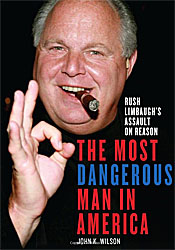
For example, a highly critical book about Rush Limbaugh ("The Most Dangerous Man in America"), by John Wilson) sports a photo of Rush himself on the front cover. And given the scathing nature of how Rush is portrayed in the book as an irresponsible, sexist, racist, ideologue, one would expect that Rush signed no model release or provided consent of any kind to have him or his likeness be associated in any way with this book. Obviously, the text is editorial commentary about the controversial radio host, so no consent is necessary for using the photo on the book itself.

But what about the promotion and advertising for the book? Both of those are "commercial" in nature: profits are made, and the book itself is a product. Again: promotion is "commercial use." Full Stop. So, one would think that Rush would have his lawyers find any legal position possible to stop or slow down the supply chain, from the photographer to the stock agency to the publisher. Yet, there it is in full color, used to both promote and advertise the book.

The reason a release is not required is not because this was the photo used on the book, but because this photo—or most any photo—would not cause a common person to believe that Rush is an advocate or sponsor of the book. (If there were a photo of Rush standing proudly next to a poster sized replica of the book, then such a photo could suggest he advocated the book, although the existence of such a photo would be unlikely.)

So, the fact that a photo is used as part of a promotion is a red herring. Photos may be on web pages, in portfolios, and presented for sale, yet the "advocacy" question is not satisfied simply because photos are displayed. There has to be more context to imply advocacy.

This is true of non-commercial uses as well. Non-profit companies often believe they can use photos of people in their materials because they are implicitly "non-commercial." But again, the determining factor is whether the person could be perceived as an advocate or sponsor of the organization.

Speaking of supply chain, note that the photographer who shot the photo of Rush Limbaugh didn't need a release to take the picture or to sell the image; he didn't need to know what the buyer was going to use it for, assuming he was even aware that someone was buying it. Similarly, a stock photo agency can display the image online, which is how the book publisher (Thomas Dunn Books) found it.

The moral of the story is, take "commercial use" out of your vernacular, and only focus on the "advocacy" question. And while that's the right place to start, such assessments are not always easy; people disagree on specific cases and argue incessantly.

A common example is photographer's own self-promotional pieces. Naturally, most believe that these are "commercial use" of images, but again, that's not the sole trigger. Most images used as part of a piece that promotes someone as a photographer is almost universally interpreted by the public as "examples" of the artists' work, not necessarily as advocates for them. Such an assertion would require text, often in the form of a quote praising the photographer's work. That context would require consent from the person depicted.

As for being in the business of selling photos, photographers are never responsible for having to know the answer the "advocacy question." Someone else is going to publish their pictures, which means that the buyer bears the risk. Photographers or stock agencies can't be responsible for how other people use the images they acquire, especially because one can't make the advocacy assessment until the photo is ultimately put to use, which is long after the financial transaction took place.

Lastly, there are portfolios: Photographers do not need releases for photos for these.

First, a portfolio is rarely considered a "promotional" item, unless it's put together very poorly. Professional portfolios consist of a collection of artistic works that demonstrate the skills and talents of the photographer. For any given image to be interpreted as to suggest the subject were an advocate for the photographer, particular text would have to be used, which is not typical for a good portfolio, which means that permission is not required in order to use photos of people. This includes all forms of publication of the portfolio, whether in physical form, or as a website, or other media.

The one thing to be aware of, however, is that sometimes photographers take pictures of people in special, "closed sessions," where an agreement was made ahead of time—before the photo was taken. If a subject posed for a photographer with the pre-arranged agreement that the photos would not be used in a portfolio or any other manner, than that agreement takes precedent. (Of course, a new agreement, such as a model release, can supersede it.) Such an agreement would have to be established first--it cannot be retroactively enforced.

That said, any good photographer would honor such a request, even if he or she didn't have to.

Labels: , , , , , , , , , , ,

Wednesday, September 28, 2011

Busting Myths about Model Releases

The internet is a virtual echo-chamber of facts and myths of all sorts. When something goes viral, there's no stopping it. Even the most blatant falsehoods can perpetuate for years if they cause no harm in believing them. An example is the myth that the different regions of the tongue tastes different types of things: sweet in the front, sour in the back, etc.. In fact, all taste buds are identical, but the myth started from a single, faulty study in the 1800s that was published in a school text book, and it's been repeated ever since.

In the photo business, the greatest myths are those involving model releases. If you have ever considered selling (or licensing) photos on your own, or through a stock agency, you've probably been told that photographers need "model releases" to sell photos of people, and "property releases" to sell photos of buildings and the like. Some stock agencies actually reject images unless these photos have releases.

While it's true that model release are necessary for certain situations, the actual laws about these issues are deep and complex. As rumors and hearsay perpetuate on the net, the over-simplification has resulted in virtually all the "advice" and conventional wisdom about model releases to be entirely wrong. And the reason why these myths perpetuate is because they cause no harm. No one ever got sued for having a model release. So, people follow the advice because they (and others) seem to be safe, perpetuating the myths.

So, why address the myths about model releases? Because photographers are losing enormous opportunity by not trying to sell the images they don't have releases for, and by going to great lengths to get releases they don't need. Despite the rumors, most publications of photos are not the type that need releases anyway, resulting in an enormous market of buyers. Most photographers could continue to have very successful businesses without ever getting model releases, all while doing exactly what they are doing today. Sure, releases are important for many types of publishers, so if you do get releases for their benefit, you can expand your buyer base by getting them. But it's a proportionally smaller market than people think, and the time, effort and resources necessary to properly obtain, manage and catalog releases is rather substantial. This investment will rarely be offset by the incremental income from sales of images that actually do require releases.

This article attempts to help the photographer looking to make money by setting the record straight on the most common myths about model releases.

Fact #1: You do not need a model release to take pictures.

Nuff said. Don't let anyone tell you otherwise. Everyone in the world has a camera on their phones, and photos are taken constantly. You don't need someone's permission to take their pictures. Now, just because you might eventually intend to sell your photos has nothing to do with the ability to take pictures in the first place.

Fact #2 You do not need a model release to sell pictures. And "profit" has no effect on whether a release is required.

First, newspapers buy photos, and their use of the photo is unlikely to need a release. So, selling a photo (and making a profit doing so) to a newspaper also does not require a release. And because the law does not require you to have any knowledge of the buyer or their intended use of a photo, you are always allowed to sell photos without a release.

Fact #3 You do not need a model release to make photos available for sale, either on your own website, or through a stock agency.

If one can sell a photo without a release, one must also be able to "make photos available for sale" without a release. This includes the publication of such photos in a manner that would allow potential buyers to find them.

The legal case that established precedent for this was Corbis vs. James Brown, where the judge called the depiction of a photo as being for sale a "vehicle of information". Here, consent from a subject is not required.

Therefore, one can make photos available for sale in any manner of publication and media, whether it's traditional print or online formats, including personal web pages, photo-sharing sites, social media sites, stock photo sites, or mostly anywhere.

For detailed information, see the article, Model Release Primer.

Fact #4: A "property release" is NOT required to sell or buy photos of buildings or people's personal property (like land).

The root of this misunderstanding is complicated. The term "property" in an actual "property release" refers to two particular forms of intellectual property: trademarks and copyrights. Examples include logos, designs and other works.

Now, just because these are "protected" works, it doesn't mean that one cannot publish photos of them. It only means that the manner in which such works are depicted cannot cause confusion among the general public about who "owns" the properties, or other legally complex factors. It is impossible for a photo of a bottle of coke to cause the general public to suddenly think that the Coca Cola company was now owned by a freelance photographer in Topeka. If the photographer sold the image to a publisher, and the publisher's use of the image would imply that it had a unique and special business relationship with Coke, then that would trigger a trademark infringement claim. But that would be with the publisher, not the photographer, nor the stock agency that sold the image. Furthermore, such an infringement couldn't possibly happen by merely the photo being printed. Text around the photo would have to give this impression. And, since the photographer or anyone selling such a photo cannot know or control how a publisher uses a photo, they could never be held liable for the infringement.

Like the myth about the tongue's different taste regions, the history of the "property release" stems from a single misimpression from long ago. Certain physical structures, such as the Golden Gate Bridge and the Transamerica building in San Francisco happen to be registered trademarks. And, they have been infringed upon inappropriately in the past, but these were cases that have nothing whatsoever to do with photography. And at the time, news of these suits briefly caused publishers to shy away from publishing photos of such places unless photographers could provide property releases for them. Those releases were not for the buildings, but for the right to use the trademarks. This was very short-lived, however, because it is impossible for photographers to obtain "true" (and legally valid) property releases for trademarks without paying enormous sums of money. So, even though the publishers stopped asking for those releases, the rumor perpetuated nonetheless: photographers erroneously interpreted these requests as "mandates" that all photos of buildings required "property releases." And they've been behaving that way ever since.

To be crystal clear, property releases are not required to sell or resell photos of buildings and other real estate (or physical property of any sort, such as land, pets, livestock, homes, etc). If something happens to be a registered trademark (building or otherwise), then the publisher will already be quite aware that they are the ones that need to obtain permission from the trademark owner (which may not even be the building owner). Any permission obtained by the photographer would be entirely useless to the publisher. In fact, every single property release used by photographers gives no legal right to use a trademark, and since buildings and other items do not require consent for photos of them to be used, these property releases are worthless pieces of paper. But they also cause no harm.

For more, see Photographers' issues concerning trademarks and photography.

Fact #5 You usually do not need permission to shoot pictures of (or on) private property.

While it's true that property owners can restrict photography, that's not saying much. They can also stop you from picking your nose. It's their property, so they can stop anyone from doing anything. You've seen signs that say, "No shoes, no shirt, no service." There's also the sign that reads, "We reserve the right to refuse service to anyone." In short, property owners can apply restrictions indiscriminately and inconsistently and arbitrarily.

But, the owner has to proactively take an action to prevent you from doing things. It's not that you're prohibited from actions by default, and they then grant you permission later. So, most of the time, there are rarely (if any) actual restrictions property owners enforce.

This includes taking pictures. It's permitted by default, and to prevent it they must take explicit actions, including (but not necessarily limited to) posting signs, as noted above. If you are not stopped (or are given reasonable advanced notice), any photos you take are legitimate, and can be sold legitimately. (See later section on "ownership.") Further, one may not retroactively enforce their restriction. That is, if you were at a private event, and then later told you were not allowed to take pictures, it has no affect on your photos or your ability to sell those images. (Publishers, on the other hand, may need releases if the nature of the publication would require it. But that doesn't affect the photographer's liability.)

So, if you're in a bar, or in an amusement park, or touring a winery, you are allowed to take pictures unless you're told not to while you're there. And if you do take pictures, you can sell them to any buyer willing to assume the risk, if any exists.

Sometimes, photographers will often seek permission to shoot pictures ahead of time. This is not only unnecessary, but invites someone from stopping them. If you know ahead of time that you will need permission, that's another story.

Fact #6: You do not need releases for Art, Books, Exhibitions, Presentations, Fairs, Contests, Postcards, Calendars, Etc.

At the risk of over-simplification, the only time a release is needed is if a person can be seen as supporting or advocating an idea, product or service. True, there are often disputes about whether a given publication of a photo of someone could be construed in such a way, but the dispute gets closer into the safety zone when that publication is a form of artistic expression. The First Amendment of the US Constitution protects "artistic exhibitions" (and publications) as a form of free speech, so consent from anyone else—by definition—is never required. Money or profit has nothing to do with whether a work is published or "depicted in an artistic manner."

Again, people argue frequently about whether such depictions are, in fact, artistic in nature, which leads to a complex argument: is it art, and if not, is it a promotion, and if so, is it the type of promotion that should have required consent from the person in the photo?

While these are all good questions, the reality is that no one has ever successfully won the argument that a model release was necessary for a photo that was used in a book, in an art gallery, or at a fair, or any of the items in the above list. In short, the law is on the side of the First Amendment by default - a claimant bears the burden of proving otherwise, and that's a difficult and very expensive bar to clear. While is indeed a very deep and complex subject, those wishing to seek quick answers can feel relaxed: "don't worry. You're fine."

For for more info, I encourage you to read this.

Fact #7: Photographers do not need releases for photos in their portfolio.

A portfolio is a collection of artistic works that demonstrate the skills and talents of the photographer. Permission is not required in order to use photos of people in a portfolio. This includes all forms of publication of the portfolio, whether in physical form, or as a website, or other media.

The one thing to be aware of, however, is that sometimes photographers take pictures of people in special, "closed sessions," where an agreement was made ahead of time—before the photo was taken. If a subject posed for a photographer with the pre-arranged agreement that the photos would not be used in a portfolio or any other manner, than that agreement takes precedent. (Of course, a new agreement, such as a model release, can supersede it.)

For more on this, see Personal Privacy and Model Releases

Fact #8: Posting photos online is just another form of publishing.

What determines the need for a release is whether a photo makes someone appear to support, advocate or promote ideas, products or services. The medium itself is irrelevant, whether it's traditional physical media, or online/electronic media. One cannot say whether a release is required for photos "posted on the web" because it depends on the way the photo depicts the person in it.

When photographers put images on their professional website, they think that this suggests that the people in those photos could be construed as sponsors or advocates, but that's not complete. Putting photos online to "sell" does not require a release, depictions of "art" do not require a release, and a "portfolio" does not require a release. The only way a photo would require a release is if the photographer created a self-promotional piece (such as an ad) that promoted his or her services, and used a photo of someone that might suggest it is a client.

Fact #9 Ownership of physical pictures and ownership of rights are different.

When people hire photographers to take pictures of them, they think they own the photos, or have rights to publish them. They don't. This has to be agreed upon, usually ahead of time (but it can be negotiated later.) Normally, this isn't a problem. But where things break down is when subjects don't like the photos of themselves. Here, they try to demand them back, but they don't have this right. (They also cannot retract permission if it's been granted in writing, such as a model release.)

The same thing is true of pictures taken on (or of) people's property. They think that because it's their house, or their private event, or their pet, that they have the rights to the photos. They don't. Nor can they stop the photographer from publishing those photos. Non-humans do not have inherent rights, unless protected by trademark or copyright.

Concusion

The reality is that photographers (and stock agencies) don't get sued for the publication of an unreleased image. And given the very high cost of suing someone, litigants are usually told by their lawyers to go after the "publishers" of the images in question, as they are the ones who bear the true legal liability.

As an active photographer, understand that most people are entirely uninformed about model releases, and factor this into your business dealings. Publishers, stock agencies and many others may vehemently demand a model (or property) release before buying photos, or for accepting your images into a stock agency. Despite their being wrong, this is the way of the world, and you can only do what they ask, or don't play.

But don't underestimate the sales potential of your unreleased images, and the large market of buyers who don't make such demands.

For those with interest in reading the details, I have many articles that answer all the technical questions, like this one and this one. I also wrote a book called, Photographer's Guide to Model Releases.

Labels: , , , , , , , , , , , , ,

Sunday, January 23, 2011

The perils of taking advice from pros

I got an email today that seems to be representative of a common thread I'm seeing. I included excerpts from the original sender and my responses:

In Chapter 7 you note that in 2000 you increased your image library, and had a big spike in traffic (2000 visitors/month). If you don't mind me asking, approximately how many images did you have online entering 2000?


I have no idea. And though I appreciate the motivation for your question, the milestone comparisons are inapplicable. The major reason my success back in 2000 was that there was virtually no appreciable photo content online. Anyone that put photos online did well. Most pro photographers were still shooting film, and the time and cost of getting that media scanned and online was a major barrier for photo imaging growth. While digital cameras were around, their resolution and image quality were too low to have much commercial value till 2003 (Canon's EOS 1Ds was the first camera that could produce an acceptable professional image quality for commercial production.)

So, whatever size my archive was, or photo quality, it was easier to succeed. So, don't look at my past as having any relevancy to today's market.

I tried to advise pro photographers to do this back then, but most were adamant that it would cause more harm to have images "stolen", and that film-based stock photo agencies were still the only viable distribution channel. It was this heated argument that propagated my postings (and my website) to other websites, which resulted in my getting so many links, which translated into traffic, which helped elevate my site rankings, which translated into sales.

(Ok, I'll admit it: I probably also had a lot of worthwhile photos to buy.)

A big part of my strategy is blogging on my image creation and some of the places I have visited where images were taken. I'm trying to be as search engine friendly and optimized as I possibly can, per your suggestions.


My suggestion is not to be "search-engine friendly", per se. It's to rank highly in search results. The two are not the same, and you don't achieve high rankings by having search engines merely find you and index you accurately. (That's being "friendly".)

Ranking highly in search engines requires other sites to link to your site. The value of those links are assessed by the ranking of those sites, which affect your ranking. Search engines are aware of people attempting to game the system through "link exchanges". Accordingly, you can reduce your own rankings if you try to agree with other sites to link to each other as a way of increasing each of your link counts. Those sites rank poorly, and so will yours, if you do link exchanges.

So the question is, who do you want to link to you?

Writing articles on "image creation" and "the places you've been" will attract mostly other photographers. And they don't buy photos. While it is certainly desirable to have highly-ranked photo-centric websites link to you, this is a very narrow market, and not one that will boost your overall rankings that ultimately attract image buyers.

If you're going to invest time into blogging, you want NON-PHOTOGRAPHY sites to link to you. How do you do that? By blogging about subjects that probably have less to do with photography as the other subject.

My advice has always been to be an expert in something other than photography. Write about that and cross-post your articles to discussion forums or other formats to attract new and different audiences. If they regard your knowledge and opinions as valuable, they will link to you, talk about you, and regard you as credible. This is what will raise your site's ranking.

Do I follow my own advice? Well, not as much as I should. Yes, my site has a lot content about photography (business and techniques), and yes, I rank highly for that. But again, I did this back in the 1990s and early 2000s, when such things mattered. It doesn't matter that much anymore. I would not be successful today by repeating the same steps I did back then, so don't emulate me just because I capitalized on what was at one time a successful technique.

More recently, I have a great deal of non-photography content as well -- mostly in the form of photos, of course. But here's where I've dropped the ball. I don't spend nearly the kind of time talking about non-photo subjects as I should. I am in the fortunate position where I don't really have to. And that's the part that doesn't translate to other, emerging photographers.

This leads to another point I've made often in the past: don't emulate other pros. What they do NOW, or have done IN THE PAST, often has no bearing on their current success, or yours. Most of them are unaware of this, and erroneously believe they have advice that emerging photographers should adopt.

See this blog post about asking pros for advice. Though it's about pricing, the concept is the same: pro photographers' opinions or experiences are not universal and cannot necessarily be expected to apply to anyone else--especially those still trying to build their careers or a presence.

There's also this related post: this one is about the perils of being a photographer's assistant, or having existing pros be "mentors." Most pros today were successful at a time where their experiences no longer apply today. Having their advice can be fraught with as much poor advice as useful, and emerging photographers cannot discern between the two.

My best advice for emerging photographers in this day and age is not to look at photographers at all -- look at general online business development. There are many texts and periodicals that deal with building business models that are more universal, and can better translate to a photography business than what narrowly-experienced pros can offer.

Labels: , , , ,

Tuesday, October 26, 2010

Flatter Stock Licensing Tiers

I was recently sent email from someone who asked very good--and very common--questions, and I thought it might be apropos for my blog:

Do you think that a price does not depend on target audience? I imagine that for web use it has not a sense, but for books, newspapers, magazines, CDs: does not it have still importance in current market?


The current stock photo market is such that simplicity is king. For the most part, buyers are no longer accustomed to pricing tiers based on the criteria you mentioned above. Back before the internet, buyers and sellers had those pricing tiers because the economics permitted it. That is, buyers understood that different uses and tiers made it possible for them to get access to commodities that used to be under much tighter controls. In the 1990s and before, stock photography was sold through glossy, elaborately designed books; if a buyer wanted a photo of a tiger, there was a page with about 10-15 images, and that was the entire lot to choose from. When the supply of images and the distribution channel are tightly controlled, the distributor has much more control over the pricing structures.

Furthermore, the supply chain between image creators and users was more complex and expensive: there's the overhead of having slides sent (both ways), the overhead of scanning and touching up photos, personnel and expertise in design and technology, all of whom were skilled and nuanced trades.

The combination of a controlled distribution channel and an expensive supply chain implied a delicate balance in the financial flexibility between buyers and sellers, each wiggling up and down in price negotiations to settle at an equilibrium: a pricing structure that allowed lower-revenue editorial clients to participate alongside their commercial counterparts. This inherent inequality was balanced by those very pricing tiers, where buyers could plan their publication budgets so that they could put more money into images that appeared on more prominent positions (e.g., a cover shot vs interior pages), or to buy more or less "exclusive" content that fit their needs.

But then the internet and digital photography came into the picture. Here, the cost of creation and distribution of images went to zero, which subsequently opened up the channel to everyone that was previously locked out: consumers, hobbyists and semi-professionals. These two factors contributed to the collapse of the entire economic "reasoning" behind the pricing structures of stock licensing. Back in 1999, I said that it'd take about 10 years for this to filter through the economic ecosystem, and the supply/demand imbalance would erode those tiers, and the pricing structures would invariably flatten.

Indeed, publications no longer hire high-end photo editors with an art degree, skilled in design, and savvy in the business of creating quality publications. As lower-skilled (and lower paid) workers leveraged increasingly more sophisticated page-layout and print software, very high-quality publications can be created at much lower physical and employment costs. This has created a fundamental shift in the economics of every single business that uses imagery, not just photographers and agencies. Every company in the world uses photos of some kind at some point in the company's lifetime, and since companies employ people, one can say that the entire world's cultural attitude about imagery shifted: it's no longer considered a skilled labor, but that of a commodity, where just about anyone can do "a reasonably good job" (not that all of them actually do).

The net effect on the photo industry is a recycling of the photo-editor staff to an entirely different kind of employee. This new photo buyer is not only unaccustomed to any of the historical tiers of pricing rationale, but they are financially constrained to work within a budget that, like it or not, yields no material difference in the overall business. In a difficult economy, where companies share the financial challenges as the employees they employ, those who try to be the Good Samaritans and help the needy photographer only find they suffer at the bottom line.

Now, all that said, there's one overwhelming factor that can be used to preserve pricing structures: the fact that the most overwhelming cost associated with acquiring images is not the license fee of an image, but the cost of search and acquisition. The huge supply of images on the internet, and the exceedingly poor search mechanisms on all search-based sites (ranging from Google to the common stock agency) means that finding images is a very costly endeavor for photo buyers, irrespective of their "skill." As I've written in the past, it often takes anywhere from 1-5 hours per image for a photo researcher to find a set of images that exceed the lowest-threshold of acceptability for their needs. The actual cost of the license is negligible compared to the cost of search and acquisition.

(Note that the latest Pulitzer Prizes for economics has gone two to economists who've used the same mechanism to explain the disparity between the high rate of employment at the same time as there is also huge amounts of unfilled jobs. They came to the same conclusion: the cost of "finding where those jobs are" exceeds the feasibility for the job-seekers to go get them.)

Accounting for this economic reality, I have flattened my pricing tiers from the more traditional menu of editorial/commercial use and "placement", to that of a single metric: the size of the image. I don't care about anything else because I'm reflecting the attitudes of modern photo buyers: they don't care or understand the older pricing rationales and just want to get the image they want and get out. They are more prone to buy when the licensing mechanism is fast and simple.

Though my prices have also lowered a bit, they have not dropped nearly at the same rate as the pricing structures found in stock photo agencies, big and small. The rate of photo buying on my site has not dropped, despite the fact that my prices are 100-1000% higher than those on microstock sites. But don't let the huge percentage ranges fool you: just because I may sell an image for $50 when a microstock might sell the same image for $1 doesn't really mean anything to the photo buyer. That cost differential is largely irrelevant. They know that in order to save $49, they have to go back to the research stage, retrofit new images into their page layout, get new approval from clients, and so on. That's not worth the $49 difference.

What about exclusivity? Have you ever licensed an
image with a exclusivity clause for a certain amount of months/years?


Perception of exclusivity is way overblown. While all buyers love the idea of using an image that no one else will use -- which often causes them to "request" exclusivity -- the economic reality is that there's very little market for that. Whenever anyone asks for it, and I quote them any kind of upcharge, they always say, "nah, forget it." The issue of exclusivity turns most photographers into worry-warts, concerned that they'll fail to get the gig, or license the image, or scare away the client... And of course, they don't know what to quote, which they feel they need to do because the client asks for a quote.

My recommendation is not to worry about this, but instead, give a simple explanation to the client that the need for exclusivity is largely overblown. Unless the image was specifically shot for the client and contains very unique or proprietary information (people, things, or access), the upcharge for exclusivity will not pencil out to be worthwhile. In a global market of many images and many businesses, the risk of having the same image used by a competitor (or anyone else) is too low to bother paying the upcharge. Yes, I am aware of the famous 'oops' stories -- these are anomalies, not truly representative of the market.


... how could you manage everything before becoming a full
time photographer? I mean your previous job, photos, website, business
analysis, blog, wife and a child?...


I have always recommended that no one should ever enter into the business of licensing photography as their sole source of income. This is not the type of job that you jump into and instantly start making money. You should always start with photography as a hobby, build your inventory, establish your web presence, participate in social networking, and set up a stock-licensing fulfillment system. And do all this while you have a real job (or income) doing something else. If you go about your hobby efficiently and effectively, your licensing income will grow, and more importantly, be sustainable and predictable. Your traffic to your site should be a repeatable wave pattern (high traffic during the week; lower on weekends), and your sales should be similarly consistent. If this data is erratic, your business is not yet established well enough to rely on it as your sole source of income.

There are many other career-building aspects to this, and I cover them all here: http://www.danheller.com/biz-sense

Labels: , , , , , , , ,

Monday, June 28, 2010

Getty and Flickr: Prophesies Coming True?

People have been emailing me copiously, asking for a statement in response to the new relationship between Getty and Flickr, where Flickr members and visitors can work with each other through a new program with Getty Images called “Request to License”. The details of this program are listed here. From that page:

When a prospective licensee sees an image marked for license, they can click on the link and be put in touch with a representative from Getty Images who will help handle details like permissions, releases and pricing. Once reviewed, the Getty Images editors will send you a FlickrMail to request to license your work, either for commercial or editorial usage. The decision to license is always yours.


Why are people asking me about this?

For years, I've been proposing that precisely this model be implemented. Most of my blog entries in 2007 and 2008 articulated this very model. The first was on Feb 13, 2007, in an article titled, "The future of photo sharing sites and agencies". There, I predicted the inevitable convergence between companies like Getty and Flickr:

I believe it will invariably happen that major photo agencies like Getty and Corbis can (and should) move into the consumer market. Consider what would happen if major stock agencies expanded their businesses by opening the flood gates and letting everyone in. By removing the barriers that require photographers to "submit images," and having a separate portion of their sites be entirely open, much like other photo-sharing sites are, they would give more options to buyers, and provide more opportunities (and greater incentive) for photographers to join at all levels. Getty owns iStockPhoto.com, which is a microstock agency that sells images for much less, but this is not a consumer-based, social networking style photo sharing site like flickr is.


The key here is in italics: microstock agencies are not social networking sites, they are therefore limited by both buyers are sellers than the social-networking sites. My premise for this logic is based on my years of research showing that 80% or more of licensed images is peer-to-peer, directly between buyers and photographers, not among agencies. You can read this research in the article, "The Size of the Photo Licensing Market"). The summary of that research is this basic truism: Most buyers find images on non-stock agency websites.

On Feb 18, 2007, I wrote how the photo-sharing and social-networking sites can capitalize on this opportunity in an article titled, "Two-Phased Approach to photo-sharing/licensing model". I said:

Phase One of this business will be where a photo-sharing site merely allows visitors to license images directly from the site. Phase Two will involve the distribution of the same photo assets to other sites, much the same way online ad sales are hosted (or "published") on other websites. ... For the sake of discussion, I'm going to assume that the approach ultimately adopted is the one I've suggested in the past: make it pure and simple by giving the user a toggle for setting whether his photos are (or aren't) permitted to be "sold".


And that's exactly what Getty and Flickr are doing now. Over four years later.

You may note that I said there was a two-phased approach. That second model will eventually become part of more photo-licensing business models. (In fact, it already exists, but among companies too small to get anyone's attention--partly because the technology and business models they've adopted do not properly understand and implement the true nature of photo licensing, copyright issues, and potential target markets. This is an aside for the moment; it may come up again when larger players eventually begin to consider the opportunities.)

Speaking of predictions, I remain steadfast in my opinion of the inevitability of what happens next:

In July, 2007, my blog post titled, "The Solution to Getty's Woes" explained how Getty can get out of its financial troubles by simply buying Flickr directly from Yahoo and using it as the main stock licensing engine. The article got into exceedingly detailed analysis of Getty's financial model (and troubles) combined with the explosion of available imagery on sites like Flickr that make this solution not only obvious, but inevitable.

On a directly related note, I called into question the life expectancy of the Creative Commons in this article (2008), where I again proposed that Flickr allow users the option of choosing between allowing their images available for free via CC, or to get income from their images. I said,

...it begs the question about whether enough people would choose the option to "make my images free"(CC) if it were next to the checkbox that says, "pay me a quarter if someone's dumb enough to buy it."

And then there's the buyer. If they were given the choice between "free images, with disclaimers and risks" and modestly priced images without such risks, it wouldn't be very likely that the "free" versions would be chosen very often.

The concept of CC would never survive under these two conditions.


Without getting too far afield, I have no qualms with the CC, per se. It's more about how simplistically it's been designed and deployed. It's just not sustainable in the real world business market. The problem is not the "license terms" and the structure of the legal contracts--those are all just fine. It's the fact that the system can be gamed so easily by both buyers and sellers, that it's too unreliable to be sustainable beyond a small handful of casual users (by comparison to the larger market of stock imagery). The true protections for both buyers and sellers is to leverage the copyright registration mechanism. That is, creative commons images that are also registered with the copyright office lowers the risk both both buyers and sellers, as explained in that article. Since no one is building copyright registration into their online business models, and the CC itself has a fundamental objection to the concept of copyright in the first place, the CC will be relegated to an historical footnote , bringing strength back to the for-fee licensing model. And which brings us back to why I'd always argued that Flickr should have enabled image licensing.

So, why is this all good for the photo licensing industry? I articulate this answer in the blog entry I wrote on March 15, 2007 in the article titled, "Photo-sharing-licensing sites leveling the playing field."

As more companies engage in the business of licensing images, photographers with credibility will gravitate to the sites that offer a better return on their money... In a way, this is how photo agencies started in the very beginning, only better: because photographers don't have to be "accepted," the playing field is much more level, and the market forces can be more free to let the money flow to those who really do merit the higher earnings (rather than at the whim of photo editors). The buyer, it turns out, is the best photo editor, and it will be pretty clear in short order which sites are hosting good, honest content.


I summarize with another excerpt from that article:

...the most basic, fundamental truism about photography remains: there are more people who have it as a hobby than as a profession, and the barrier to entry is low... the honeymoon period for Getty will end once photo-sharing sites become new outlets for photographers where the open market can decide their rates."

Labels: , , , , , , , , , , , , ,