




"Commercial Uses" and Model Releases
In my last blog post, "Myth-Busting Model Releases", I received quite a bit of email from people about "commercial uses"of images, pointing to other discussion forums where, again, myths and hearsay prevailed among many misinformed, but well-intentioned photographers.
The common assumption is that "commercial uses" of images require model releases, but that's not actually true. The sole trigger for whether a release is required rests on whether the subject can be perceived as supporting or advocating a particular idea, product or service. True, many "commercial" uses of images do have people appearing to be advocates, and this is where the oversimplification begins. People overlook the many commercial uses where a person can be presented without appearing to be a supporter or advocate. Similarly, there are non-commercial uses that do portray the subject as a supporter or advocate, which would require a release. Two examples follow:
On the commercial side, there are companies that sell books, magazines, newspapers and other forms of media. While the content of their media may be editorial in nature (which doesn't require a release), the promotion of their products is commercial in nature. Just because they may be promoting an editorial product, it's irrelevant. Promotion is a commercial activity. Full stop. But again, "commercial use" does not itself trigger the need for a release.
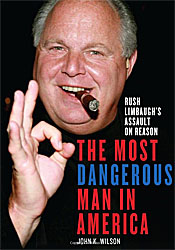
For example, a highly critical book about Rush Limbaugh ("The Most Dangerous Man in America"), by John Wilson) sports a photo of Rush himself on the front cover. And given the scathing nature of how Rush is portrayed in the book as an irresponsible, sexist, racist, ideologue, one would expect that Rush signed no model release or provided consent of any kind to have him or his likeness be associated in any way with this book. Obviously, the text is editorial commentary about the controversial radio host, so no consent is necessary for using the photo on the book itself.
But what about the promotion and advertising for the book? Both of those are "commercial" in nature: profits are made, and the book itself is a product. Again: promotion is "commercial use." Full Stop. So, one would think that Rush would have his lawyers find any legal position possible to stop or slow down the supply chain, from the photographer to the stock agency to the publisher. Yet, there it is in full color, used to both promote and advertise the book.
The reason a release is not required is not because this was the photo used on the book, but because this photo—or most any photo—would not cause a common person to believe that Rush is an advocate or sponsor of the book. (If there were a photo of Rush standing proudly next to a poster sized replica of the book, then such a photo could suggest he advocated the book, although the existence of such a photo would be unlikely.)
So, the fact that a photo is used as part of a promotion is a red herring. Photos may be on web pages, in portfolios, and presented for sale, yet the "advocacy" question is not satisfied simply because photos are displayed. There has to be more context to imply advocacy.
This is true of non-commercial uses as well. Non-profit companies often believe they can use photos of people in their materials because they are implicitly "non-commercial." But again, the determining factor is whether the person could be perceived as an advocate or sponsor of the organization.
Speaking of supply chain, note that the photographer who shot the photo of Rush Limbaugh didn't need a release to take the picture or to sell the image; he didn't need to know what the buyer was going to use it for, assuming he was even aware that someone was buying it. Similarly, a stock photo agency can display the image online, which is how the book publisher (Thomas Dunn Books) found it.
The moral of the story is, take "commercial use" out of your vernacular, and only focus on the "advocacy" question. And while that's the right place to start, such assessments are not always easy; people disagree on specific cases and argue incessantly.
A common example is photographer's own self-promotional pieces. Naturally, most believe that these are "commercial use" of images, but again, that's not the sole trigger. Most images used as part of a piece that promotes someone as a photographer is almost universally interpreted by the public as "examples" of the artists' work, not necessarily as advocates for them. Such an assertion would require text, often in the form of a quote praising the photographer's work. That context would require consent from the person depicted.
As for being in the business of selling photos, photographers are never responsible for having to know the answer the "advocacy question." Someone else is going to publish their pictures, which means that the buyer bears the risk. Photographers or stock agencies can't be responsible for how other people use the images they acquire, especially because one can't make the advocacy assessment until the photo is ultimately put to use, which is long after the financial transaction took place.
Lastly, there are portfolios: Photographers do not need releases for photos for these.
First, a portfolio is rarely considered a "promotional" item, unless it's put together very poorly. Professional portfolios consist of a collection of artistic works that demonstrate the skills and talents of the photographer. For any given image to be interpreted as to suggest the subject were an advocate for the photographer, particular text would have to be used, which is not typical for a good portfolio, which means that permission is not required in order to use photos of people. This includes all forms of publication of the portfolio, whether in physical form, or as a website, or other media.
The one thing to be aware of, however, is that sometimes photographers take pictures of people in special, "closed sessions," where an agreement was made ahead of time—before the photo was taken. If a subject posed for a photographer with the pre-arranged agreement that the photos would not be used in a portfolio or any other manner, than that agreement takes precedent. (Of course, a new agreement, such as a model release, can supersede it.) Such an agreement would have to be established first--it cannot be retroactively enforced.
That said, any good photographer would honor such a request, even if he or she didn't have to.
The common assumption is that "commercial uses" of images require model releases, but that's not actually true. The sole trigger for whether a release is required rests on whether the subject can be perceived as supporting or advocating a particular idea, product or service. True, many "commercial" uses of images do have people appearing to be advocates, and this is where the oversimplification begins. People overlook the many commercial uses where a person can be presented without appearing to be a supporter or advocate. Similarly, there are non-commercial uses that do portray the subject as a supporter or advocate, which would require a release. Two examples follow:
On the commercial side, there are companies that sell books, magazines, newspapers and other forms of media. While the content of their media may be editorial in nature (which doesn't require a release), the promotion of their products is commercial in nature. Just because they may be promoting an editorial product, it's irrelevant. Promotion is a commercial activity. Full stop. But again, "commercial use" does not itself trigger the need for a release.
For example, a highly critical book about Rush Limbaugh ("The Most Dangerous Man in America"), by John Wilson) sports a photo of Rush himself on the front cover. And given the scathing nature of how Rush is portrayed in the book as an irresponsible, sexist, racist, ideologue, one would expect that Rush signed no model release or provided consent of any kind to have him or his likeness be associated in any way with this book. Obviously, the text is editorial commentary about the controversial radio host, so no consent is necessary for using the photo on the book itself.
But what about the promotion and advertising for the book? Both of those are "commercial" in nature: profits are made, and the book itself is a product. Again: promotion is "commercial use." Full Stop. So, one would think that Rush would have his lawyers find any legal position possible to stop or slow down the supply chain, from the photographer to the stock agency to the publisher. Yet, there it is in full color, used to both promote and advertise the book.
The reason a release is not required is not because this was the photo used on the book, but because this photo—or most any photo—would not cause a common person to believe that Rush is an advocate or sponsor of the book. (If there were a photo of Rush standing proudly next to a poster sized replica of the book, then such a photo could suggest he advocated the book, although the existence of such a photo would be unlikely.)
So, the fact that a photo is used as part of a promotion is a red herring. Photos may be on web pages, in portfolios, and presented for sale, yet the "advocacy" question is not satisfied simply because photos are displayed. There has to be more context to imply advocacy.
This is true of non-commercial uses as well. Non-profit companies often believe they can use photos of people in their materials because they are implicitly "non-commercial." But again, the determining factor is whether the person could be perceived as an advocate or sponsor of the organization.
Speaking of supply chain, note that the photographer who shot the photo of Rush Limbaugh didn't need a release to take the picture or to sell the image; he didn't need to know what the buyer was going to use it for, assuming he was even aware that someone was buying it. Similarly, a stock photo agency can display the image online, which is how the book publisher (Thomas Dunn Books) found it.
The moral of the story is, take "commercial use" out of your vernacular, and only focus on the "advocacy" question. And while that's the right place to start, such assessments are not always easy; people disagree on specific cases and argue incessantly.
A common example is photographer's own self-promotional pieces. Naturally, most believe that these are "commercial use" of images, but again, that's not the sole trigger. Most images used as part of a piece that promotes someone as a photographer is almost universally interpreted by the public as "examples" of the artists' work, not necessarily as advocates for them. Such an assertion would require text, often in the form of a quote praising the photographer's work. That context would require consent from the person depicted.
As for being in the business of selling photos, photographers are never responsible for having to know the answer the "advocacy question." Someone else is going to publish their pictures, which means that the buyer bears the risk. Photographers or stock agencies can't be responsible for how other people use the images they acquire, especially because one can't make the advocacy assessment until the photo is ultimately put to use, which is long after the financial transaction took place.
Lastly, there are portfolios: Photographers do not need releases for photos for these.
First, a portfolio is rarely considered a "promotional" item, unless it's put together very poorly. Professional portfolios consist of a collection of artistic works that demonstrate the skills and talents of the photographer. For any given image to be interpreted as to suggest the subject were an advocate for the photographer, particular text would have to be used, which is not typical for a good portfolio, which means that permission is not required in order to use photos of people. This includes all forms of publication of the portfolio, whether in physical form, or as a website, or other media.
The one thing to be aware of, however, is that sometimes photographers take pictures of people in special, "closed sessions," where an agreement was made ahead of time—before the photo was taken. If a subject posed for a photographer with the pre-arranged agreement that the photos would not be used in a portfolio or any other manner, than that agreement takes precedent. (Of course, a new agreement, such as a model release, can supersede it.) Such an agreement would have to be established first--it cannot be retroactively enforced.
That said, any good photographer would honor such a request, even if he or she didn't have to.
Labels: commercial use, dan heller, legal, model release, model releases, non-profits, photo agencies, photo business, photography, photography business, stock agencies, stock photography
posted by argv | 9:14 PM

