
Dan Heller's Photography Business Blog Industry analysis from www.danheller.com

The photography world -- the business, the culture, the art, the politics, the technology.

Site Feed

Subscribe to
Posts [Atom]

View mobile version

My Photo
Name:
Location: Santa Cruz, California, United States
My Books on the
Photography Business

Friday, February 17, 2012

Selling Stock: it's about search rank, not price

Yesterday, I reposted an article I originally wrote in 2007, discussing the misconception that microstock pricing is what's driving down overall license fees.

I got a few emails that still challenged my assertion, and it appears I haven't emphasized strongly enough the most compelling arguments supporting this thesis.

All of my research supports the premise that the primary cost of licensing images is not the license fee, but the overhead associated with finding and acquiring the right image. The overhead and administration of a project that would involve photo licensing shows that the actual license fee ranks very low on the budget -- hence, low on the buyer's priority list. My 2007 surveys of buyers showed that.

If the person responsible for finding images for a project is paid $60/hr, and this person spends 2-3 more hours looking for a photo just to pay $1 vs. $50, this translates to paying someone $120-180, just to save $50. People who control budgets know that the license fee for photos is negligible to the total cost of production, even at the traditional stock photo rates. The bigger the project, and lower the proportion of the license fee for the image(s).

Those who sell images are dropping their prices because they're looking at their competition, not the buyer. Further, there is absolutely no evidence to show that sites that have lower prices sell more images. There is definitely a perception that there's a correlation, but that's because people are comparing apples to oranges. Getty sales vs iStock sales are not apples-to-apples because the two entities vary dramatically in search engine results (and other important factors). People talk about microstock sites more, and they link to them (in blogs, discussion forums) and the quantity of images on microstock sites is rapidly growing. So naturally, these sites get higher rankings in search results. Search engines don't rank sites because they have lower prices. They rank sites by size (content), links, and a black magic formula that is best described as "dispersion of discussion in and around the net." In short, microstock sites have more content and get more attention. Hence, better rankings, which translates to more traffic, which attracts more photographers to submit images to them, perpetuating the feedback loop.

In my 2007 survey, those who indicated they were aware of--and use microstock sites-- most don't go to them because the prices are lower; it's mostly because those sites ranked higher in search engine results, where the buyer starts.

Because search engine ranking drives traffic -- especially the untapped (and unaware) segment of the global economy that doesn't use stock agencies -- and because the greatest cost in photo acquisition is time, not the license fee, 90% of the time-savings is the image results the user gets on that initial search. If it takes the buyer to a stock agency site -- microstock or otherwise -- then the deal is nearly done. Price notwithstanding.

This is primarily why I have advocated for years that stock sites should focus their entire effort towards optimizing search engine rankings. While they could have done something about it in the past, the rise of social networks and the plethora of image-related websites and apps has made it impossible for agencies to rank highly on image-search rankings on their own. In today's market, they have no choice but to either partner with, or acquire/be-acquired-by a social-networking site.

The Getty<->Flickr combination is a very pragmatic example. Yahoo is circling the drain, and it needs to shed its non-performing assets and focus its attention on ... something. Whatever that is, it isn't Flickr, and there aren't a lot of buyers that would be interested in that asset, except for Getty or Corbis. The combined product would involve retooling Flickr to be far more socially active (to keep up with modern social networking trends), and to integrate licensing/acquisition into the user/social experience. Most importantly, to provide incentive programs for photo submitters to participate economically. (I've written a great deal about this in the past.)

Of course, perhaps Yahoo should just buy Getty. Facebook is getting into the game, which tends to lead one's eyes towards Google, but they are still struggling to play catch up in the social-networking arena, and their photo division is not run by someone with a disposition towards stock or an awareness of the economics of the photo industry. The company is more interested in building assets that support their advertising model. There's no evidence that "licensing" is on their radar--a pity because they would be on the forefront of the Web 3.0 economic model, where images would play a huge role. (See here.)

In the meantime, there's a $25B shadow economy in peer-to-peer photo licensing that's up for grabs. (See here.)

So, you ask, "how do you convince agencies of this?"
I've been trying since 1998.

(For fun, see this web archive of my site from 1999 discussing this topic.)

Labels: , , , , , , , , , , , , , ,

Sunday, November 13, 2011

Creative Commons Effect on Photo Licensing

Julie Bernstein asked me the following question: "I am curious if your views on Creative Commons have changed since the four articles you published on this topic in '08."

Julie is referring to these articles (part1, p2, p3, p4) where I describe the CC as a great licensing method for almost all media types except photography.

In summary, what the CC has done is create a legally legitimate infrastructure for those who freely share copyrighted works. Before CC, such activity was technically an infringement, because the the publication of creative works requires consent of copyright holders. CC clears up that technicality, which is great. But it has inadvertently given people the impression that it has affected the licensing industry's pricing structures.

CC has not affected the greater licensing market (or prices), largely because of risk: CC has no centralized authority to assure that content is either submitted properly or used properly. Because it's so easy to game the system on either side of the photo (the supplier or the user can sue the other by luring them with a legally misleading scenario), the financial liability for anyone with a lot to lose is simply too high, especially given that traditional license fees are so minimal. So, the majority of image buyers simply stay away from CC.

Now, this is not to suggest there's something wrong with the CC model in principle. I'm a big advocate for it in all other contexts. Indeed, it was born out of the "free software" meme that was popular in the 1980s and 90s, when Gnu Public License (GPL) and other models were the precursors to the "open-source" model we still enjoy today. These are great innovations in licensing because they allow intellectual property to be used for the greater good, while also allowing for commercial use of those innovations.

But CC in the world of engineering is entirely different from photography. Engineering takes a considerable amount of time, resources and (usually) teamwork to produce anything of value that those in the open-source community would use. As such, the kind of content there is proportionally minimal, and each work is substantial and recognizable, making infringements quite easy to spot.

None of this is true in photography -- trillions of images are produced daily, it's impossible to track any given photo, or whether it is "legitimate" (either by the owner or the user).

So, sure, in a world of honest people that want to freely share their content in a peaceful corner of the image licensing market, CC is great. The CC market is growing, but the perception is only as a measurement of itself, not the total licensing market. An article on that topic can be found here:
http://www.danheller.com/blog/posts/total-size-of-licensing-market.html

Lastly, it's natural to ask, "If CC is so easy to game, why haven't we seen it?" The answer is because the market is so negligible. Economists often use crime data as a reality check on the economic activity they think they're aware of. The higher the crime rate, the more economic activity there is, and there's usually parity between that activity and the presumed size of a commodity's market. If there's little crime, the market size isn't big enough to warrant the effort. If CC were to genuinely gain momentum, it would attract those who would game the system for profit, which itself would have a cooling effect, bringing its popularity back down.

For the record, I've proposed that the best way to assuage people's risk concerns about CC is to use the "copyright registration" system. The CC foundation should have a submission system where those who want to submit images for CC licensing would bulk register those images to the copyright office. This gives them the right to file claims on behalf of the copyright owner, which is how major stock agencies like Getty work. Registered images are eligible for higher level of copyright protection, and there are federal penalties for fraudulent use. This means that users of CC images can be protected from invalid claims by those trying to game the system because this is built into the copyright act's provisions. Similarly, authors can be assured of CC compliance because non-compliant users could be subject to an infringement claim. Yes, you can sue someone for copyright infringement, even if the license fee were zero, because the infringement is another form of "breach of contract." Here, the user of a CC image agreed to the terms of CC by (for example) citing copyright ownership. Failing to do so is an infringement of that contract, and is therefore subject to the statutes provided by copyright law.

This would not only allow CC to have actual teeth, but the trust would go up as the risk comes down.

But such an infrastructure would be quite expensive to operate. That'd be a tall order just to create a system that brings the license fee for a commodity down only a few dollars, even if it is only to zero.

Labels: , , , , , , , , , , , ,

Friday, September 30, 2011

"Commercial Uses" and Model Releases

In my last blog post, "Myth-Busting Model Releases", I received quite a bit of email from people about "commercial uses"of images, pointing to other discussion forums where, again, myths and hearsay prevailed among many misinformed, but well-intentioned photographers.

The common assumption is that "commercial uses" of images require model releases, but that's not actually true. The sole trigger for whether a release is required rests on whether the subject can be perceived as supporting or advocating a particular idea, product or service. True, many "commercial" uses of images do have people appearing to be advocates, and this is where the oversimplification begins. People overlook the many commercial uses where a person can be presented without appearing to be a supporter or advocate. Similarly, there are non-commercial uses that do portray the subject as a supporter or advocate, which would require a release. Two examples follow:

On the commercial side, there are companies that sell books, magazines, newspapers and other forms of media. While the content of their media may be editorial in nature (which doesn't require a release), the promotion of their products is commercial in nature. Just because they may be promoting an editorial product, it's irrelevant. Promotion is a commercial activity. Full stop. But again, "commercial use" does not itself trigger the need for a release.


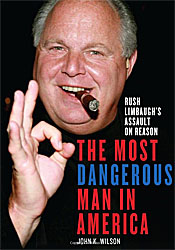
For example, a highly critical book about Rush Limbaugh ("The Most Dangerous Man in America"), by John Wilson) sports a photo of Rush himself on the front cover. And given the scathing nature of how Rush is portrayed in the book as an irresponsible, sexist, racist, ideologue, one would expect that Rush signed no model release or provided consent of any kind to have him or his likeness be associated in any way with this book. Obviously, the text is editorial commentary about the controversial radio host, so no consent is necessary for using the photo on the book itself.

But what about the promotion and advertising for the book? Both of those are "commercial" in nature: profits are made, and the book itself is a product. Again: promotion is "commercial use." Full Stop. So, one would think that Rush would have his lawyers find any legal position possible to stop or slow down the supply chain, from the photographer to the stock agency to the publisher. Yet, there it is in full color, used to both promote and advertise the book.

The reason a release is not required is not because this was the photo used on the book, but because this photo—or most any photo—would not cause a common person to believe that Rush is an advocate or sponsor of the book. (If there were a photo of Rush standing proudly next to a poster sized replica of the book, then such a photo could suggest he advocated the book, although the existence of such a photo would be unlikely.)

So, the fact that a photo is used as part of a promotion is a red herring. Photos may be on web pages, in portfolios, and presented for sale, yet the "advocacy" question is not satisfied simply because photos are displayed. There has to be more context to imply advocacy.

This is true of non-commercial uses as well. Non-profit companies often believe they can use photos of people in their materials because they are implicitly "non-commercial." But again, the determining factor is whether the person could be perceived as an advocate or sponsor of the organization.

Speaking of supply chain, note that the photographer who shot the photo of Rush Limbaugh didn't need a release to take the picture or to sell the image; he didn't need to know what the buyer was going to use it for, assuming he was even aware that someone was buying it. Similarly, a stock photo agency can display the image online, which is how the book publisher (Thomas Dunn Books) found it.

The moral of the story is, take "commercial use" out of your vernacular, and only focus on the "advocacy" question. And while that's the right place to start, such assessments are not always easy; people disagree on specific cases and argue incessantly.

A common example is photographer's own self-promotional pieces. Naturally, most believe that these are "commercial use" of images, but again, that's not the sole trigger. Most images used as part of a piece that promotes someone as a photographer is almost universally interpreted by the public as "examples" of the artists' work, not necessarily as advocates for them. Such an assertion would require text, often in the form of a quote praising the photographer's work. That context would require consent from the person depicted.

As for being in the business of selling photos, photographers are never responsible for having to know the answer the "advocacy question." Someone else is going to publish their pictures, which means that the buyer bears the risk. Photographers or stock agencies can't be responsible for how other people use the images they acquire, especially because one can't make the advocacy assessment until the photo is ultimately put to use, which is long after the financial transaction took place.

Lastly, there are portfolios: Photographers do not need releases for photos for these.

First, a portfolio is rarely considered a "promotional" item, unless it's put together very poorly. Professional portfolios consist of a collection of artistic works that demonstrate the skills and talents of the photographer. For any given image to be interpreted as to suggest the subject were an advocate for the photographer, particular text would have to be used, which is not typical for a good portfolio, which means that permission is not required in order to use photos of people. This includes all forms of publication of the portfolio, whether in physical form, or as a website, or other media.

The one thing to be aware of, however, is that sometimes photographers take pictures of people in special, "closed sessions," where an agreement was made ahead of time—before the photo was taken. If a subject posed for a photographer with the pre-arranged agreement that the photos would not be used in a portfolio or any other manner, than that agreement takes precedent. (Of course, a new agreement, such as a model release, can supersede it.) Such an agreement would have to be established first--it cannot be retroactively enforced.

That said, any good photographer would honor such a request, even if he or she didn't have to.

Labels: , , , , , , , , , , ,

Friday, January 21, 2011

(New Photos) On the Nile: Cruising from Cairo to Aswan

I just posted a new gallery of photos from the photo expedition I lead in Egypt over Christmas. You can view them here:
http://www.danheller.com/egypt

I also shot time-lapse footage of select scenes here:
http://www.youtube.com/watch?v=UKB6EmqoBjA

Labels: , ,

Tuesday, October 26, 2010

Flatter Stock Licensing Tiers

I was recently sent email from someone who asked very good--and very common--questions, and I thought it might be apropos for my blog:

Do you think that a price does not depend on target audience? I imagine that for web use it has not a sense, but for books, newspapers, magazines, CDs: does not it have still importance in current market?


The current stock photo market is such that simplicity is king. For the most part, buyers are no longer accustomed to pricing tiers based on the criteria you mentioned above. Back before the internet, buyers and sellers had those pricing tiers because the economics permitted it. That is, buyers understood that different uses and tiers made it possible for them to get access to commodities that used to be under much tighter controls. In the 1990s and before, stock photography was sold through glossy, elaborately designed books; if a buyer wanted a photo of a tiger, there was a page with about 10-15 images, and that was the entire lot to choose from. When the supply of images and the distribution channel are tightly controlled, the distributor has much more control over the pricing structures.

Furthermore, the supply chain between image creators and users was more complex and expensive: there's the overhead of having slides sent (both ways), the overhead of scanning and touching up photos, personnel and expertise in design and technology, all of whom were skilled and nuanced trades.

The combination of a controlled distribution channel and an expensive supply chain implied a delicate balance in the financial flexibility between buyers and sellers, each wiggling up and down in price negotiations to settle at an equilibrium: a pricing structure that allowed lower-revenue editorial clients to participate alongside their commercial counterparts. This inherent inequality was balanced by those very pricing tiers, where buyers could plan their publication budgets so that they could put more money into images that appeared on more prominent positions (e.g., a cover shot vs interior pages), or to buy more or less "exclusive" content that fit their needs.

But then the internet and digital photography came into the picture. Here, the cost of creation and distribution of images went to zero, which subsequently opened up the channel to everyone that was previously locked out: consumers, hobbyists and semi-professionals. These two factors contributed to the collapse of the entire economic "reasoning" behind the pricing structures of stock licensing. Back in 1999, I said that it'd take about 10 years for this to filter through the economic ecosystem, and the supply/demand imbalance would erode those tiers, and the pricing structures would invariably flatten.

Indeed, publications no longer hire high-end photo editors with an art degree, skilled in design, and savvy in the business of creating quality publications. As lower-skilled (and lower paid) workers leveraged increasingly more sophisticated page-layout and print software, very high-quality publications can be created at much lower physical and employment costs. This has created a fundamental shift in the economics of every single business that uses imagery, not just photographers and agencies. Every company in the world uses photos of some kind at some point in the company's lifetime, and since companies employ people, one can say that the entire world's cultural attitude about imagery shifted: it's no longer considered a skilled labor, but that of a commodity, where just about anyone can do "a reasonably good job" (not that all of them actually do).

The net effect on the photo industry is a recycling of the photo-editor staff to an entirely different kind of employee. This new photo buyer is not only unaccustomed to any of the historical tiers of pricing rationale, but they are financially constrained to work within a budget that, like it or not, yields no material difference in the overall business. In a difficult economy, where companies share the financial challenges as the employees they employ, those who try to be the Good Samaritans and help the needy photographer only find they suffer at the bottom line.

Now, all that said, there's one overwhelming factor that can be used to preserve pricing structures: the fact that the most overwhelming cost associated with acquiring images is not the license fee of an image, but the cost of search and acquisition. The huge supply of images on the internet, and the exceedingly poor search mechanisms on all search-based sites (ranging from Google to the common stock agency) means that finding images is a very costly endeavor for photo buyers, irrespective of their "skill." As I've written in the past, it often takes anywhere from 1-5 hours per image for a photo researcher to find a set of images that exceed the lowest-threshold of acceptability for their needs. The actual cost of the license is negligible compared to the cost of search and acquisition.

(Note that the latest Pulitzer Prizes for economics has gone two to economists who've used the same mechanism to explain the disparity between the high rate of employment at the same time as there is also huge amounts of unfilled jobs. They came to the same conclusion: the cost of "finding where those jobs are" exceeds the feasibility for the job-seekers to go get them.)

Accounting for this economic reality, I have flattened my pricing tiers from the more traditional menu of editorial/commercial use and "placement", to that of a single metric: the size of the image. I don't care about anything else because I'm reflecting the attitudes of modern photo buyers: they don't care or understand the older pricing rationales and just want to get the image they want and get out. They are more prone to buy when the licensing mechanism is fast and simple.

Though my prices have also lowered a bit, they have not dropped nearly at the same rate as the pricing structures found in stock photo agencies, big and small. The rate of photo buying on my site has not dropped, despite the fact that my prices are 100-1000% higher than those on microstock sites. But don't let the huge percentage ranges fool you: just because I may sell an image for $50 when a microstock might sell the same image for $1 doesn't really mean anything to the photo buyer. That cost differential is largely irrelevant. They know that in order to save $49, they have to go back to the research stage, retrofit new images into their page layout, get new approval from clients, and so on. That's not worth the $49 difference.

What about exclusivity? Have you ever licensed an
image with a exclusivity clause for a certain amount of months/years?


Perception of exclusivity is way overblown. While all buyers love the idea of using an image that no one else will use -- which often causes them to "request" exclusivity -- the economic reality is that there's very little market for that. Whenever anyone asks for it, and I quote them any kind of upcharge, they always say, "nah, forget it." The issue of exclusivity turns most photographers into worry-warts, concerned that they'll fail to get the gig, or license the image, or scare away the client... And of course, they don't know what to quote, which they feel they need to do because the client asks for a quote.

My recommendation is not to worry about this, but instead, give a simple explanation to the client that the need for exclusivity is largely overblown. Unless the image was specifically shot for the client and contains very unique or proprietary information (people, things, or access), the upcharge for exclusivity will not pencil out to be worthwhile. In a global market of many images and many businesses, the risk of having the same image used by a competitor (or anyone else) is too low to bother paying the upcharge. Yes, I am aware of the famous 'oops' stories -- these are anomalies, not truly representative of the market.


... how could you manage everything before becoming a full
time photographer? I mean your previous job, photos, website, business
analysis, blog, wife and a child?...


I have always recommended that no one should ever enter into the business of licensing photography as their sole source of income. This is not the type of job that you jump into and instantly start making money. You should always start with photography as a hobby, build your inventory, establish your web presence, participate in social networking, and set up a stock-licensing fulfillment system. And do all this while you have a real job (or income) doing something else. If you go about your hobby efficiently and effectively, your licensing income will grow, and more importantly, be sustainable and predictable. Your traffic to your site should be a repeatable wave pattern (high traffic during the week; lower on weekends), and your sales should be similarly consistent. If this data is erratic, your business is not yet established well enough to rely on it as your sole source of income.

There are many other career-building aspects to this, and I cover them all here: http://www.danheller.com/biz-sense

Labels: , , , , , , , ,

Tuesday, December 01, 2009

Time-Lapse of the Sky over Puglia, Italy

Once again, I have new time-lapse videos up on YouTube, and the latest is this series of scenes from Puglia, Italy (the southern "heel" of the boot):


If you don't see the video displayed above, see this link.

On a separate note, I'm also offering a 50% discount on print orders, and an additional 10% off on book orders through Christmas. Use the discount code "xmas" when placing an order.

Labels: , , ,

Sunday, November 29, 2009

Why there's no one-stop shop for photo buyers

I got an interesting email today from someone that prompted me to address a question on many people's minds: why hasn't a single website emerged as the "primary" place to license images? As those in the photo industry know, Getty sells quite a bit, and microstocks fall behind them, followed in turn by a smattering of pro photographers and others who do well as individuals. But, with the trillions of photos on the web, and with the sheer magnitude of opportunity, what's really the barrier to growth?

Here's an excerpt from his email:

do you think that there could be an issue with just straight up too much content for buyers (all buyers)? Say for example - there was a website that everyone knew was the place to buy and sell images for any sort of use (commercial, etc.)? Couldn't there still be too many shots of a 'dog'? ... if all the buyers/sellers universally knew this was the place for images - wouldn't the back-end functionality of a site like this take an army of programmers to design? I have to wonder why something like this doesn't already exist or is in development by a major player like google?


Saying that there's too many photos out there is like saying that Google can't index the web because there are too many sites. And thinking that there could be a single go-to site for buyers and sellers is like saying that there's could be single go-to site to buy electronics. There aren't because there's competition, etc. But, the reason why there's a viable, stable market for electronics (unlike photos) is because there are mechanisms in place that help establish price points, distributors, manufacturers, and so on. In short, it's a mature industry.

The same cannot be said of the photo industry for a variety of reasons.

To begin, it's not that there's "too much content" it's that there's no reliable mechanism for sifting through it. Go to images.google.com and type "two men shaking hands" -- a common image search for business purposes. Though the matches are generally accurate, the results are also entirely arbitrary. We have no idea if these are popular images, or they are shot by famous people, or if they are "current", or even whether the source (website) is ranked highly.

The same is true for every website that displays photos--buyer website or not. "Arbitrary results" is why buyers have trouble finding what they want quickly and easily. Yet, despite the huge number of sites that talk about "swine flu", a quick search on that topic usually gets you exactly what you want on the first page. You can even misspell it -- say, "swing flu" and still do well.

So the first problem that people have to solve is search. And this is irrespective of where people go. Now, people can argue about whether real buyers go to search engines or to stock agency sites, but the technology barrier exists nonetheless. Who's going to solve it? It cannot--by definition--be a stock agency. Why? Because they will not (and cannot) return results that are photos they cannot represent.

Whether now or in the future, search engines will be how most people (yes, buyers) find photos.

Now that's not to say that companies like Getty couldn't solve the problem. In fact, they should. To do so, however, they would change their business model from being an exclusive seller to one that acts as a proxy for others -- a grand middle-man, much like how Visa and Mastercard merely enable transactions with an infrastructure. They don't actually participate in the transaction itself.

The reason why Getty won't be coming to the table here is that they suffer from two basic errors in their understanding of the photo industry: first and foremost, they don't see the market outside of their existing world of traditional ad/media buyers. Yes, that's a big industry, and Getty services them adequately. But it's tiny in the broader world of image licensing transactions. And this leads to their second grave misunderstanding: the belief that the best way to service buyers is to have limited content that's hand-edited by seasoned photo editors.

This is not in keeping with the internet today. As we have all learned in the past decade, Web 2.0 means that the "crowd" is the editor, and order among the crowd is achieved by applying intelligent ranking algorithms, tracking their behaviors, and mining user preferences to glean predictability. Getty doesn't do this. No one does this. (Well, google does with their regular text search for non-image content.)

Getty's model of knowing and understanding what buyers want is fine if you have one-to-one relationships with them, and that's what Getty's good at. I'm not suggesting that Getty doesn't keep what they have in-house. It's what they don't have -- what needs to be built -- that they lack, and what the industry needs.

For the industry to become "mature", there must exist two main functions: (1) a search and ranking system that returns reliably accurate results beyond any measure we see today, and (2) a predictable and viable pricing model that represents a true market-maker commodity market.

Granted, these are not simple problems to solve, but there is precedent for similar algorithms. For instance, Google took quite a few years before they came up with just the right mix of variables and weightings to determine which web pages match a given user's search criteria. A similar list of factors can be derived to determine quality image searches in a variety of contexts.

In the photo world, everyone looks to metadata (such as keywords) as the primary factor, but that's quickly morphing into something else. It's a longer discussion to have, but it sums up this way: google stopped looking at web pages' "keywords" field in metadata because it became unreliable--the system can be gamed, and bad players were ruining the reliability of google results by lying about the content of their web pages. Google solved this problem by no longer looking at web pages' keywords settings, and did their own semantic analysis of web pages to determine what keywords should really be associated with them.

It's not that "keywords" themselves will go away in images, but the future of image search will go well beyond user-editable metadata. Factors like "age" (current-ness), supplier, number of views, frequency of (published) use, and automated programmatic analysis about images to assess various conceptual attributes as well. Hard? You betcha. Yet, just as it took google years to come up with their "hundreds of variables" that determine a web site's ranking for any given search term, so too will effort have to go into determining the relevancy of any given photo search.

There are various image recognition algorithms that can begin to move in this direction, but once you get into the science of it, the field is much broader than people think. There are proximity algorithms to determine if two images are the same, there are content algorithms to determine image characteristics (color, textures, emptiness, focus, etc.), and pattern recognition (faces, emotions, objects, and other patterns). Underneath every image recognition algorithm must be a hierarchical database of seed information to spin the world into motion so that trillions of images can be automatically processed from web crawlers continuously.

And this science isn't just to determine search relevancy: it would also be used by an auction-based system to set pricing for a trading system, exactly like how google prices keywords for its advertising system. This is not simple college algebra, but it's also not science fiction. Similar models have been built to create efficiencies for more complex markets than photo licensing. (Personally, I envision a structure similar to the formulas used for pricing stock options. Here, rather than having a big/ask market of quotes, prices are derived from external data based on aggregating a weighting of historical pricing patterns for images with similar characteristics.)

So, who's going to do it? Therein lies the $64,000 question.

Here, there are two problems: As just described, there's a lot of technology here, ranging from all the various image-search algorithms to the pricing analytics. This by itself is already way beyond what any one company has done. So, whoever's going to attempt this must likely be large enough to go on a bit of a buying spree.

Secondly, there needs to be a general realization that there's money to be made. This is difficult when the cultural behaviors around photos is to share, steal, or do whatever you want. Most investors don't really see the "vision" of a viable worldwide market with these sorts of things become further embedded in our online social fabric. This, despite the fact that research shows that photo licensing is still a $25B industry anyway. Comprised mostly of peer-to-peer transactions, it is now precisely how the online advertising industry was before Google.

More reading on the true size of the photo industry can be found here.

Google could solve both problems outlined above, but that would introduce another problem: They are in the advertising business. If they were to enter a business that monetized content on the web, it would bring into question the objectivity of their search/ranking algorithms, which is the only reason people trust their advertising model. That is, buyers and advertisers believe the pricing model because Google currently has no financial interest in monetizing the content on any given site.

What the world needs is a search engine from a company whose business model is not to sell advertising. Yahoo is becoming a much more likely candidate for something like this (as I'd noted in this blog post), but the catch-22 here is that if they were that visionary, they'd have started this kind of development with their Flickr property years ago. Yes, Flickr could be a good launch pad for such an endeavor, but Flickr's too busy with other things to bother with such fantasies.

Then there's Microsoft: they have the money and the infrastructure to actually accomplish this feat, especially given their efforts to build a good search engine. Their physical and political proximity to Corbis (started by Bill Gates) could also be a substantial contributor to the transaction and pricing models that will be needed.

But I dont' have faith that we'll be seeing headlines in these areas anytime soon. That may change with the evolution of Web 3.0... For that, see this post:

http://www.danheller.com/blog/posts/economics-of-migrating-from-web-20-to-30.html

Labels: , , , , , , , , ,

Saturday, November 07, 2009

Marketing Tasks vs Positioning Strategies

In a discussion forum on LinkedIn a while ago, a photographer in the UK named Clare-Louise posts a question, "What's the best way to market myself?"

The responses come flooding in: "Put your best portfolio together and send it to as many people as you can," writes one. "Do a direct mail marketing campaign," says another. "Build a great flash website," chimes a third. "Write about yourself in a blog," echoes the crowd.

All these ideas are those you've no doubt heard a million times, and many people swear by them, citing personal anecdotes to success. Yes, one should do these things. But that's not saying much. Everyone does these things. If you were to interview a room full of lottery winners, each will tell you their technique. But as you know, picking numbers is, despite the claims of the winners, nothing but luck. And so is photography, at least insofar as the marketing is concerned.

It's not that some photographers or their works aren't genuinely "better" or more appropriate for a given client than others. There are differences. The randomness comes in from the sheer volume and noise received by those who sift through it all, because they are flooded with portfolios and emails from people just like you. No matter how much you tweak, or categorize, or improve, or anything else to differentiate your photography or your presentation, the huge volume of noise that photo buyers/editors get means that such attention to detail is not going to yield much more of a difference than random chance—that someone just happened to be in the right frame of mind when he saw your portfolio.

Yes, you will find the winners that say, "I wouldn't have gotten that job had I not sent in that portfolio!" But what about the hundreds or thousands of others that did exactly the same thing, but didn't get hired. If you were to look at their contributions, you would be hard-pressed to see such a discernable difference as well, helping you appreciate just how arbitrary photo editors and art directors are.

Predictably photo buyers would strenuously disagree with this. They genuinely believe that they have unique insight into which photographer is the best one to hire. And in their minds they're right because of their own track record; their ratio of success to failure is so high because they're smart.

This is what I call this the inverse-lottery game, where almost every ticket is a winner. For them, the photographer they choose will likely do a good job because, despite what they'd like to admit, almost all of them would be perfectly suited. It's like the game that toddlers play where they pick from a tubful of rubber duckies that has a star taped underneath. In their world, they pick a duck, turn it over, and surprise! They win! They really think they knew what they were doing. But the reality is, all the ducks had a star.

That's OK. Let them think that. Here's where your strategic planning can be put to best use: When you contact someone, don't even mention photography. Instead, discuss business. Keep in mind this truism: A great photographer with bad business skills will rarely get work, but a mediocre photographer with great business skills will rise to the top.

Note that I'm not saying you shouldn't send in portfolios and try to establish first contact. You should! But that's not the whole picture. The problem with this approach is that it's based on a faulty premise: that getting hired is all about your skill as a photographer. The point is, these are tasks, not strategies.

Marketing tasks is one thing. Positioning is another. Most photographers don't position themselves. And positioning is how you establish how you are perceived as a whole, not just as an artist. Whether buyers know it or not, they have bias towards individuals that are in tune with their businesses and the issues they face. Positioning yourself as such a person is your goal.

Effective positioning can be done in an infinite number of ways, each of which involves writing and speaking authoritatively on matters pertinent to your target clients. You need to articulate a vision statement about their business.

If you really want to jump ahead of the class, you need to make yourself stand out in ways that make you more than just a photographer--you need to appear as an expert in the business of your target clients. You want to be seen as someone that can help with their business objectives by offering the "outside expert" insight, to help them see the forest for the trees that they can't do because they're in the woods. You need to offer perspective from a broader industry outlook because you have your fingers on the pulse of many companies, perhaps even their competitors.

It may sound like I'm suggesting you to actually be an expert, or to sound like a CEO. I'm not. I'm merely suggesting you talk about things you know, and use them in your promotional materials, especially in ways that are either independent of photography, or which use photos only as examples to illustrate business points. Not as a demonstration that your photography is great. (You already do that with your portfolio, website and other stuff.)

The advice above usually throws off most artists right off the bat. They think it's entirely counter-intuitive to talk about anything except photography if that's their ultimate goal. Worse, they vastly underestimate their knowledge and experience in the fields of their own photography, and they certainly underestimate the relevancy of this knowledge, especially when they are emerging in their careers and trying to get work. When I've done individualized consulting for those who get "stuck' in their careers, simple discussions on these subjects often reveal that their insight and analysis on matters in their subjects is quite advanced.

So, let's now look at Clare-Louise that started this discussion. Her website, which is at www.clare-louise.co.uk, is full of self-produced images, but you'd never know it--they look like pieces she's done for other clients. So when she posted her question to the LinkedIn forum, I was curious as to the story behind the story.

When we started talking, I probed into what here interests are, what industries she knows, her experience and expertise, and so on. This got her talking about topics that she thought was mundane and unimportant; to me, her knowledge was way over my head. She clearly knew about fashion design much better than I did, and I've known some good fashion photographers. I can only imagine she'd hit it off very well with photo buyers or editors.

Her problem was that she was only contacting them as a hungry and unemployed photographer. The psychology aspect alone put her much further behind everyone else. If, instead, she approached prospective clients with a more business-oriented approach, she'd get much better responses.

So what should she – or anyone – do? Positioning is key, and that's done by demonstrating your knowledge and expertise about a subject. Obviously, blogging is the best way to do that. If what you say and think is truly useful and wise, then your career will follow. You need to talk about stuff that buyers are interested in. Don't talk about yourself, your personal life, or what you enjoy about photography. Buyers don't care about these things -- they won't even go to your blog. You want people to land on your blog as a search result they did on a keyword that you talk about.

Another good way is to frequent discussion boards on the subject of your expertise, not photography discussion boards. Get to know people in your industry, network with them, socialize with them, and join their professional associations. If you know who's who in the field of your photography (not the photography itself), you'll have much better insight into where opportunities are.

Let's say you're a fashion photographer that focuses on children's clothing, and you wanted to contact a potential buyer at Sears. You Google her name and see what she's written, where she posts things, a blog she might have, or any other mention. Now, imagine what response you'd get if you started with, "I saw what you said about last year's catalog. Did you see the line-up for kids this fall? The fashion magazines are calling it a big departure for the pre-teens, and I hear Macy's is stocking up ahead of the curve. What do you think?" She wouldn't possibly know that this is a pitch from a photographer looking for work. This is just business banter between colleagues in the same industry.

You are more likely to not only get a reply back than if you just sent a cold-call email asking to send a portfolio. You're starting off as peers, not the master-servant relationship they're used to. Here's your opportunity to foster the relationship. The nature of your discussion will start off on a professional level, far from what this person would have ever expected from a photographer--certainly not a new and inexperienced one. Your goal is to show that you know this topic because you're experienced and informed on the subject (even if you aren't—you're also learning). Before you know it, something about "photography" comes up in conversation, and you'd be in a much better position to posture as someone she could use.

So, yes, contact clients, send portfolios, write a blog, have a sexy website. But those should be minor and incidental tasks that you take up every so often as a regular course of business. Spend your time and resources developing serious and valuable materials focusing on your knowledge of the businesses and industries that are the focus of your photography. Once you have those things, you can reshape them any one of these marketing forms long into the future.

I discuss this topic in much greater detail in my book, Profitable Photography in the Digital Age, which can be found at http://www.danheller.com/books

Labels: , , ,